Monday, January 10, 2011

TEACHING READING IN PHASE 0 IS E-A-S-Y!

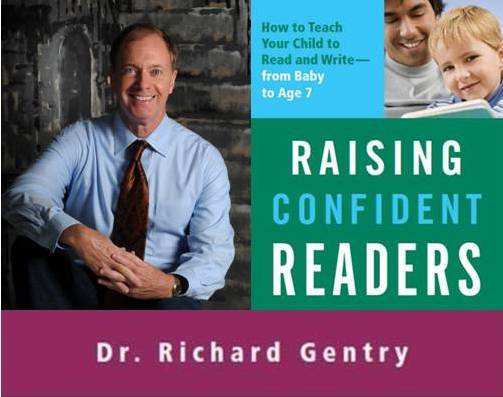
From page 67 of Raising Confident Readers:


TEACHING READING IN PHASE 0 IS E-A-S-Y!

Teaching babies and toddlers in Phase 0 is E-A-S-Y. Just Remember:

E is for Early start.

A is for Activities.

S is Stimulation.

Y is for You.
Early Start
Your baby's brain is ready for reading at birth. Even before birth, if you are reading a children's storybook aloud, baby's brain responds to the  musical quality of the sound, which she can already hear from inside the womb. If you are her mother, she will recognize your voice within a few days after her birth.....
...There is overwhelming evidence that starting early with language is an advantage. Printed language is a visual form of communication--just as sign languagefor deaf children is a visual language.
 Read more from Raising Confident Readers and find out what you as a parent or teacher can do to help put your children on the road to literacy.

Raising Confident Readers is available at Amazon.com (Raising Confident Readers)
Find out more about Richard Gentry and his work at http://www.jrichardgentry.com/.
Follow him on FaceBook at http://www.facebook.com/J.Richard.Gentry and on Twitter at http://twitter.com/RaiseReaders.

Monday, October 11, 2010

The Science of Spelling, Implications of Discovery #2

The question:

"How are teaching strategies for young emerging spellers different than those for older skilled spellers, and how does the difference relate to brain scan research?" (SOS, p13)

Find the answer in the Science of Spelling, The Explicit Specifics That Make Great Readers and Writers (And Spellers!), Dr Richard Gentry's book that explains the science behind teaching spelling.


Discovery # 2: The Emergence of Spelling Ability and Ability to Spell Words Correctly and Automatically Are Different

(From The Science of Spelling (SOS), Gentry, Chapter 2)


"....learning to spell, which generally should happen in kindergarten and first grade, is very different from being a good speller (that is, spelling words correctly and automatically, which generally evolves in grades two through eight." (p13)

There are two phases of spelling:
  1. Phase I, Learning to Spell ("learning how to represent words with alphabetic letters," p.13, SOS)
  2. Phase II, Spelling Correctly and Automatically ("adding new, correct spelling entries to the dictionary of the brain," p17, SOS)
Implications:

"Implications from the discovery that the emergence of spelling and correct and automatic spelling are different fall into two categories. The first set of implications relates to the emergence phase of spelling/writing/reading. The last implication relates to Phase II." (SOS, p22)
  1. "Kindergarteners and first graders should invent spellings and write frequently..."
  2. Teachers should "pay attention to developmental levels of spelling," using "informal assessments such as the Monster Test (Gentry 1982) to further track development..."
  3. "Differentiate instruction during Phase I based on levels of writing."
  4. "Provide early intervention during Phase I for students who are not meeting expected levels of writing achievement."
  5. "Provide explicit spelling instruction during Phase II for increasing writing and reading fluency." (SOS, pp 22-23)
For more a more details on Dr. Gentry's two phases of spelling, read Chapter 2 of The Science of Spelling, available on Amazon.com.

J. Richard Gentry, Ph.D., is an internationally acclaimed author and researcher and is recognized for groundbreaking work in spelling and Pre-K through second-grade emergent literacy. His breakthrough insights on the early connections of reading, writing, and spelling are unraveling the mysteries of how teachers should teach and how children learn to read and write. His new book for parents, Raising Confident Readers, is the culmination of more than 30 years of experience in childhood education. He is also the author of Breakthrough in Beginning Reading and Writing, Step-by-Step Assessment Guide to Code Breaking, Breaking the Code, and The Science of Spelling. His blog posts for Psychology Today offer advice to parents on raising readers, writers, and spellers.


Wednesday, October 6, 2010

The Science of Spelling: Discovery #1

There is a Neurological Basis for Spelling

‎"The implications from the discovery of a neurological base for spelling are powerful. They can be summarized in three guidelines for teaching.


1. Put spelling on a pedestal.


2. Teach spelling explicitly.


3. Change your attitudes about teaching spelling and about spelling's importance for literacy. "
 
 (Taken from The Science of Spelling, The Explicit Specifics That Make Great Readers and Writers (and Spellers!), Chapter 1, p.11-12, Gentry)
Available on Amazon.com.

Tuesday, September 14, 2010

Great Day San Antonio

I just finished my interview on Great Day San Antonio, KENS -5, CBS. They placed a link to this blog to get more information about my book Raising Confident Readers. Over the last couple of months I have been posting on my new blog at PyschologyToday.com,
 Raising Readers, Writers, and Spellers,
and not so much on this site. So in case you drop by here, check out my PT.com blog and my website,
 http://jrichardgentry.com ,
 or my Facebook page,
 http://www.facebook.com/J.Richard.Gentry,
 or my Twitter page,
https://twitter.com/RaiseReaders,
to get all the news and updates on what I am doing.

If you have questions, please email me at richard@jrichardgentry.com.

 You can see a video of  the interview on my facebook page listed above.

Thanks.

Tuesday, July 20, 2010

Phase 2, Do all Children Read the Same Way, Continued

Here's a continuation of the question we considered in my a previous blog post,  "Do all children read the same way."

To quickly review, the answer  is "yes!" I explained there are five literacy phases through which each child progresses. Phase 0 ( http://tinyurl.com/2dlfk5k) and Phase 1 (http://tinyurl.com/2d3dwcn) were highlighted in previous postings.


Now, let's  look at what happens in Phase 2, age 3 to 6


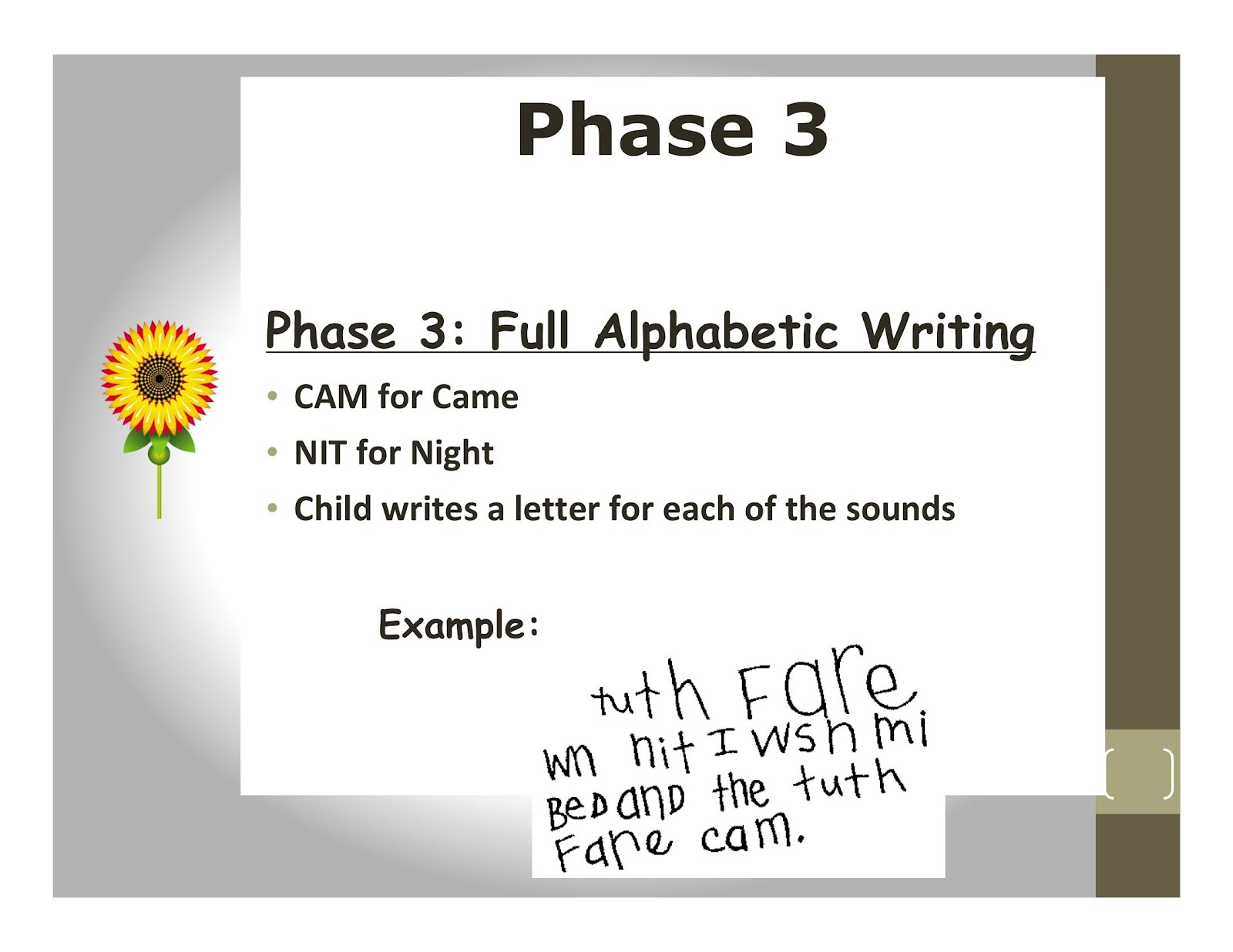
Your toddler begins learning the alphabet, matching beginning and prominent letters to sounds and labeling drawings or writing messages with a few letter-sound matches. You can read these early Phase 2 writing such as HMT DPD for Humpty Dumpty. Some of the sounds in the words are represented by letters, but not all of the sounds. Sometimes the Phase 2 writer gets only beginning or beginning and ending sounds.


"Phase 2 is exciting for both children and parents because everyday life explodes with illustrations of literacy learning. This is when children begin reading lots of easy little books from memory and writing their first messages that you can read. Your child’s mind absorbs great knowledge of letters and soon will begin to learn how sounds match with them. He or she can talk about sophisticated concepts during read alouds and book sharing. Knowledge about letters and sounds grows in leaps and bounds. Imagine the thrill of a parent being able to read the first written message from a child such as C MOM! I KN RT!" Gentry, Raising Confident Readers: How to Teach Your Child to Read and Write—from Baby to Age 7 (New York, Da Capo Press, 2010), 126

For more information on Phase 2 plus activities for moving Phase 2 readers and writers forward, see Chapter 6 of Raising Confident Readers. (Now available on line at Amazon.com or in bookstores everywhere.)

Tuesday, June 15, 2010

RCR Arrives!


I received my first copy of the Raising Confident Readers yesterday, June 14. The book looks great. Bookstores will have it on their shelves by July 15, one month from today or sooner. I am very excited about the book's potential and the impact I believe it will have for parents who want to 'raise a child who loves to read.'

Wednesday, May 26, 2010

Windy City bound

Hinsdale School District 181 (May 26-28)


I will be in the Chicago suburbs for a couple of days conducting staff development for preK through third grade teachers. The emphasis of the visit will be on teaching beginning reading, writing, and spelling with a heavy focus on beginning writing development and it's importance for learning to read.
Hinsdale School District 181 is one of the best school districts in the Chicago area.

Partnerships in education newsletter, Spring 2010, Volume 4, Number 1

Just received my copy of the Partnership in education, Spring 2010, Volume 4, Number 1 from the College of Charleston School of Education, Health, and Human Performance in which I was quoted for an article written by Christy Heitger-Ewing,  entitled, How National Standards will Change America's Schools, (pp10-13).

'..."In my 2007 book, Breakthrough in Beginning Reading and Writing, I wrote about the need for a core curriculum and core knowledge for teachers of beginning reading and writing instruction-one specific example of a possible outgrowth of national standards,"notes Gentry....'

Please be sure to check out the article and the rest of the very professional and poignant newsletter put out by the Center for Partnerships to Improve Education. Paula Eglelson, someone with whom I have work for many years is the Editor-in-Chief.

Coming up:

I will be working in the Kingsport City Schools, Kingsport City, TN in the first week of June.

Only a little over  a month or so before the release of Raising Confident Readers. Due out July 12.

Looking forward to some R & R next week as I join friends in Baltimore for an Orioles/Red Sox game at Camden Yards. Should be fun.

Look for my next post when we will continue with the series on "Do all children learn to read the same way."

Until then, keep on reading...